
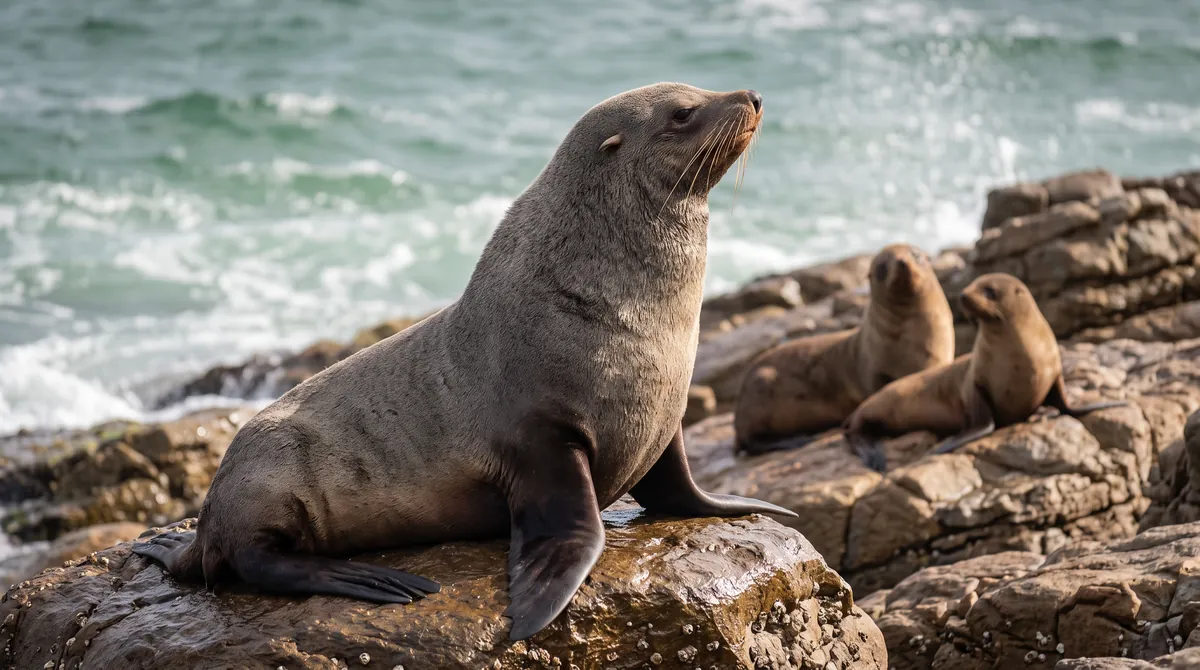
The Cape fur seal
Arctocephalus pusillus pusillus. The largest fur seal in the world, the only seal that breeds on South Africa’s coast, and the animal that will look you in the mask at Robberg.
- Scientific name
- Arctocephalus pusillus pusillusalso called the South African or brown fur seal
- Adult male
- 2.3 m200 to 350 kg
- Adult female
- 1.8 mabout 120 kg
- Typical dive
- 45 mdeepest recorded: 204 m
- Lives
- 18 yearson average in the wild
What is a Cape fur seal?
The Cape fur seal is an eared seal found only on the coast of southern Africa, from southern Angola to Algoa Bay. It is the largest of the world’s fur seals, has a thick double coat, small external ear flaps and long front flippers, and it gathers in noisy colonies on rocky shores and islands.
It has one close relative: the Australian fur seal, a second subspecies living on the other side of the Indian Ocean. Together they are known to scientists as the brown fur seal.
At sea, a Cape fur seal is fast and agile, and hunts mostly fish and squid. On land it is a different animal, hauling itself over rocks on all four flippers and arguing with its neighbours.
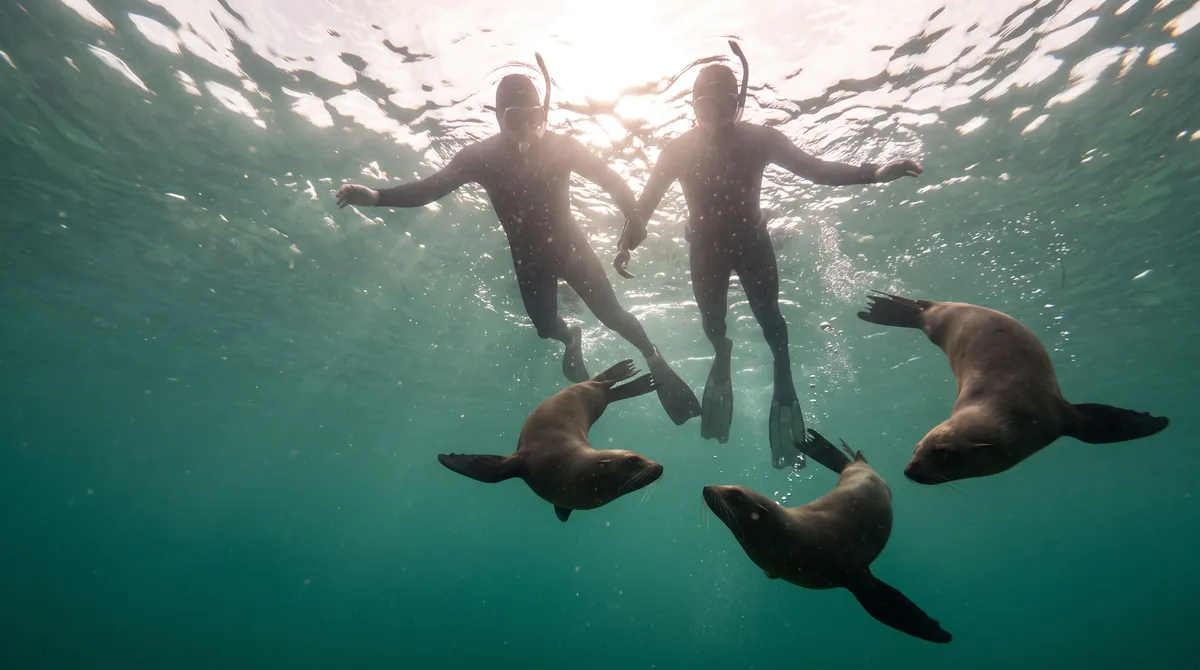
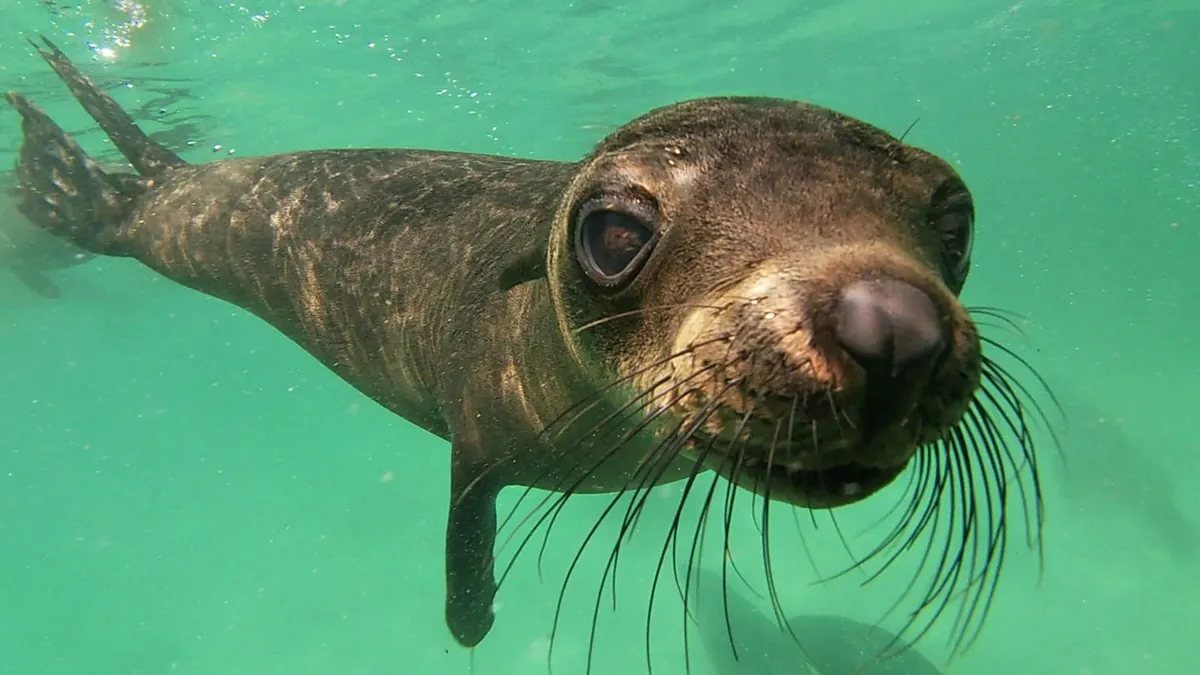 Photo from our trips
How to recognise one
Tap the numbers. Each one is something a true seal does not have or cannot do.
Ear flaps
Small rolled external ears. This is the quickest way to tell an eared seal from a true seal, which has only an ear hole.
Whiskers
Long, stiff and very sensitive. Seals use them to feel the wake of a fish in dark or murky water.
A double coat
Coarse guard hairs over dense underfur that traps air. It is this fur, more than blubber, that keeps a fur seal warm.
Front flippers
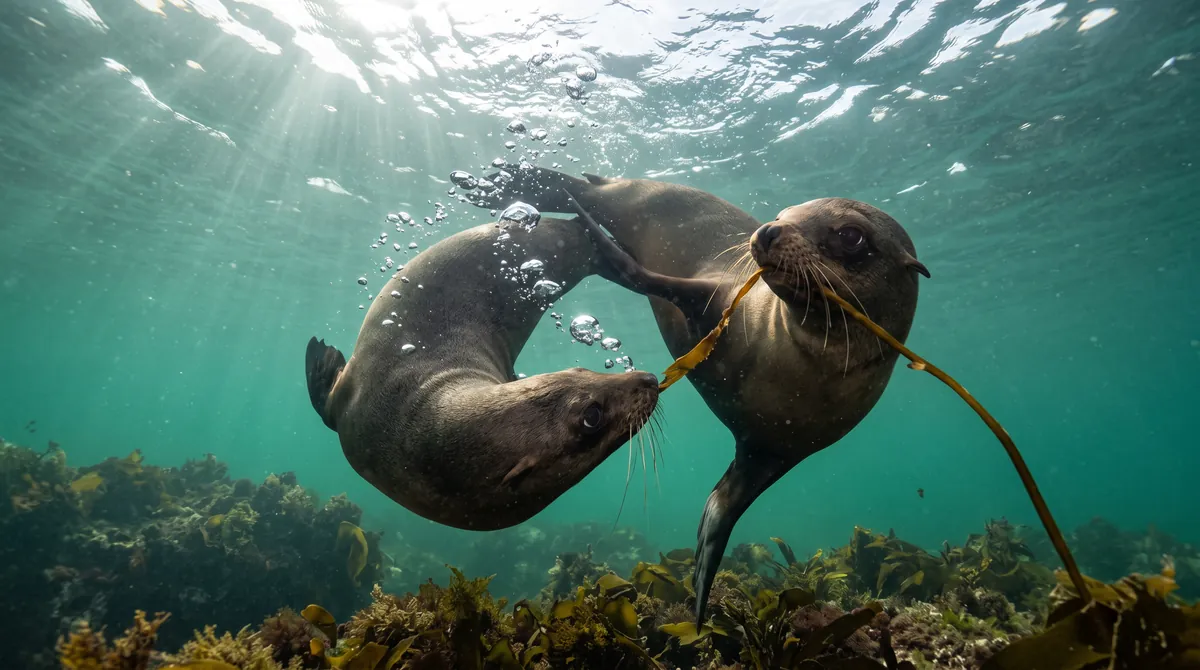
Long and leathery. Fur seals swim by rowing with their front flippers, almost like flying underwater.
Hind flippers that turn forward
Eared seals rotate their hind flippers under the body and walk, even gallop, on all fours. True seals cannot.
A year in a seal’s life
Bulls arrive first. In late spring, adult males come ashore and fight for a patch of rock. The winners hold territories with a harem that averages 28 cows.
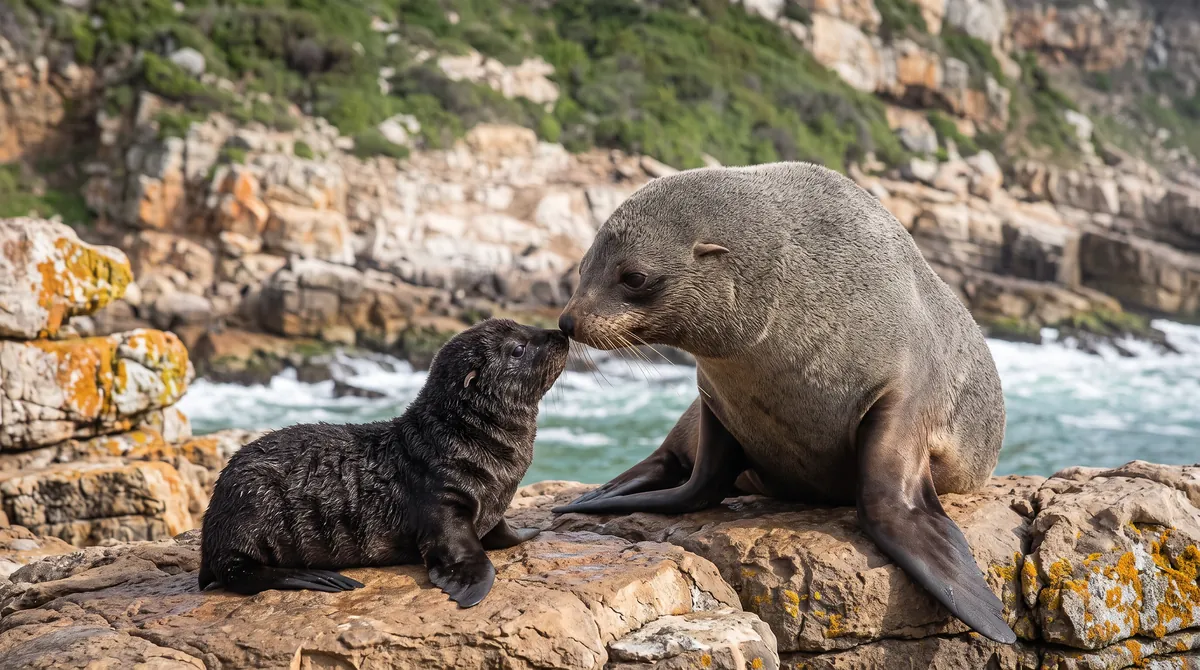
Pups are born in early summer. Most arrive from late November into December. A newborn weighs 4.5 to 7 kilograms and measures 60 to 70 centimetres, with a black, curly coat.
Mothers commute. A cow alternates feeding trips at sea with nursing on land. She finds her own pup among hundreds by its call.
Pups grow up. The black coat moults to olive grey at four to five weeks, and to a silvery coat at about thirteen months. These yearlings are the bold, playful seals snorkellers meet.
What eats a fur seal
Great white sharks and orcas are the main predators at sea. On mainland colonies, black-backed jackals take pups. This is why seals are wary at the surface, and one reason they are so quick.
People and seals
Cape fur seals were hunted hard for their pelts and oil for more than three centuries. At Robberg the colony was wiped out by the late 1800s. South Africa ended commercial sealing in 1990, the species is protected here, and its conservation status is Least Concern.
Since 2024, rabies has been confirmed in Cape fur seals along the southern African coast. See how that affects seal swims on our safety page.
Seal, sea lion or fur seal?
| Eared seals (fur seals, sea lions) | True seals | |
|---|---|---|
| Ears | Small external flaps | Ear holes only |
| On land | Walk on all four flippers | Shuffle on the belly |
| Swimming | Row with front flippers | Scull with hind flippers |
| Example | Cape fur seal | Harbour seal, elephant seal |
Fur seals differ from sea lions mainly in their thick underfur and more pointed snout.
Seal questions
Are there seals in South Africa?
Yes. The Cape fur seal is the only seal that breeds on the South African mainland coast. It lives from southern Angola, down the coast of Namibia, and around South Africa as far east as Algoa Bay. Robberg in Plettenberg Bay is one of the easternmost colonies.
Is a fur seal a true seal?
No. Fur seals and sea lions are eared seals, family Otariidae. They have small external ear flaps, walk on all four flippers and swim with their front flippers. True seals, family Phocidae, have no ear flaps, shuffle on their bellies and swim with their hind flippers.
What do Cape fur seals eat?
Mostly fish, which make up about 70 percent of the diet, then squid at about 20 percent. Crabs, other crustaceans and the occasional seabird make up the rest.
How big do Cape fur seals get?
They are the largest of the fur seals. Adult males average about 2.3 metres and 200 to 350 kilograms. Females are smaller, averaging about 1.8 metres and 120 kilograms.
What is a baby seal called?
A pup. Adult males are bulls and adult females are cows. Cape fur seal pups are born with a black, curly coat and weigh 4.5 to 7 kilograms.
How deep can a Cape fur seal dive?
A typical dive is about 45 metres deep and lasts around two minutes. The deepest recorded dives reach about 204 metres and last seven and a half minutes.
Measurements, diet, diving and lifespan figures: University of Michigan Animal Diversity Web. Range: South Africa’s NICD. Robberg history: Huisamen et al., African Journal of Marine Science, 2011. Last checked 10 October 2026.
Now come and meet them
Ready to meet the seals?
Trips leave Central Beach at 10:00, 12:00, 14:00 every day, weather permitting. Pick a date and we will have a wetsuit waiting.